Thursday, July 21, 2016

HSBC Bankers Are First Individuals Charged in U.S. Currency Case

Image result for HSBC Currency Officer charged

  • HSBC Official Said to Face Charges in FX Rigging Probe
  • Mark Johnson arrested at Kennedy Airport Tuesday in New York
  • Cairn Energy said to be the unidentified front-running victim

Federal agents surprised an HSBC Holdings Plc executive as he prepared to fly out of New York’s Kennedy airport around 7:30 p.m. Tuesday, arresting him for an alleged front-running scheme involving a $3.5 billion currency transaction in 2011.

Mark Johnson, HSBC’s global head of foreign exchange cash trading in London, was held in a Brooklyn jail overnight and will appear in court Wednesday, according to prosecutors. The U.S. unsealed a complaint against him and Stuart Scott, the bank’s former head of currency trading in Europe, making them the first individuals to be charged in the long-running probe.

The arrest and charges are a coup for the Justice Department, which has struggled to build cases against individuals in its investigation into foreign-exchange trading at global banks. U.S. prosecutors once had so much confidence in the quality of evidence they were gathering thanks to undercover cooperators that in September 2014, then-Attorney General Eric Holder said he expected charges against individuals within months. The U.K. Serious Fraud Office also found it difficult to make cases against currency traders and announced in March that it was dropping its efforts.

“This case demonstrates the criminal division’s commitment to hold corporate executives, including at the world’s largest and most sophisticated institutions, responsible for their crimes,” Assistant Attorney General Leslie Caldwell said in an e-mailed statement.

The two allegedly conspired to take advantage of inside information about an unidentified company’s plans to sell part of its stake in an Indian subsidiary, according to the complaint. The client was Cairn Energy Plc, which was selling the unit to Vedanta Resources Plc, according to people with knowledge of the transaction. HSBC was hired to trade about $3.5 billion in proceeds of the sale to pounds. Johnson and Scott began buying pounds in the days before the transaction, anticipating that they would cause the price of pounds to spike -- a practice known as “ramping” -- then execute the transaction, making the pounds they’d bought earlier more valuable, according to the complaint.

‘Element of Surprise’

Scott and Johnson -- his supervisor at the time -- told the client the deal should take place at 3 p.m. “so there’s an element of surprise” to get a better rate, according to the complaint, which quoted from recorded phone calls and messages between the two and their client. There was less liquidity at the 3 p.m. fix than the one at 4p.m., making it easier to manipulate, though they told their client they were about the same.

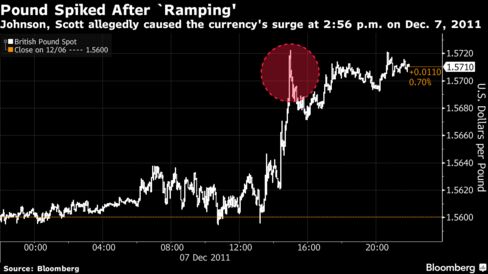
They and other traders they directed ramped the price, sending the pound to its highest in two days at 2:56 p.m. London time. When Scott told Johnson the client was still going ahead with the full transaction despite the spiking price, Johnson said “Ohhhh, f***ing Christmas,” according to the complaint. In the end, HSBC and the men’s internal accounts reaped about $8 million from the front-running, according to Brooklyn U.S. Attorney Robert Capers.


“The defendants allegedly betrayed their client’s confidence, and corruptly manipulated the foreign exchange market to benefit themselves and their bank,” Caldwell said. Johnson and Scott blamed the pound’s rise on an unidentified Russian bank in their conversations with the client afterwards, according to the complaint.

Rob Sherman, an HSBC spokesman, and Peter Carr, a Justice Department spokesman, declined to comment. Johnson and his lawyer, Frank Wohl, didn’t immediately respond to calls seeking comment. Contact information for Scott wasn’t immediately available in U.K. directories.

Extradition Concerns

Both men are British citizens. The U.S. complaint was kept under seal for fear Johnson, 50 and a resident of both the U.S. and U.K., would flee if he heard about it, according to the document. Agents moved quickly to arrest Johnson, who works in London and New York, to avoid difficulties that could arise in extraditing him, according to a person with knowledge of the matter. HSBC wasn’t made aware of the plans to arrest Johnson, another person said, asking not to be identified because the details aren’t public.

Scott left the bank in 2014 after it agreed to pay $618 million to settle currency-rigging investigations by the U.K. Financial Conduct Authority and the U.S. Commodity Futures Trading Commission. The 43-year-old remains in the U.K., and the U.S. is likely to seek extradition, according to one of the people.

Johnson’s arrest comes more than a year after five global banks pleaded guilty to charges related to the rigging of currency benchmarks. HSBC, though it settled regulatory cases, is still being investigated by the Justice Department. The bank has set aside $1.3 billion for possible settlements, according to an August filing.

Antitrust, Fraud

The Justice Department’s investigation into the manipulation of currency markets by the world’s biggest banks has looked at two issues: whether bankers from competing institutions colluded to sway benchmarks in their favor in violation of antitrust laws and whether bankers were committing fraud with client orders. The charges against Johnson and Scott were brought by federal prosecutors in Brooklyn working with the Justice Department’s fraud section in Washington.

Separately on Tuesday, the U.S. Federal Reserve banned former UBS Group AG trader Matthew Gardiner from the banking industry for life for his role rigging currency benchmarks. Gardiner used electronic chat rooms, with names including The Cartel and The Mafia, to facilitate the rigging of foreign-exchange benchmarks and to disclose confidential customer information to traders at other banks, the Fed said in a statement Tuesday. That matter is separate from the one involving Johnson, the people said.

Gardiner has been helping U.S. prosecutors who are trying to build currency-rigging cases against individuals for violation of antitrust laws, two people familiar with the matter told Bloomberg News in April. He hasn’t been publicly charged and it isn’t clear if he has been granted immunity for cooperation. A lawyer for Gardiner didn’t respond to an e-mail seeking comment.


Wednesday, July 20, 2016

It’s Not a Housing Bubble, It’s Just Expensive...(BW)

Despite record home prices in some big cities, the U.S. market is nowhere near as bad as it was a decade ago.
Image result for House Market
Home prices have hit record highs in some major U.S. metropolitan areas, and house-flippers are behaving like it’s 2005: It’s no wonder people are chattering about another housing bubble.
But residential real estate isn’t in a speculative bubble, industry observers contend. Instead, a low inventory of available homes is driving prices higher—prices, however, will eventually recede as buyers throw up their hands, or as more new homes come on line. The structural issues that led to the housing collapse last decade aren't present.
“The havoc during the last cycle was the result of building too many homes and of speculation fueled by loose credit,” said Jonathan Smoke, chief economist at Realtor.com. “That’s the exact opposite of what we have today.”    
To illustrate his point, Smoke compiled an index based on six factors he deemed crucial to the housing boom and bust of the mid-2000s, including price appreciation, the prevalence of house-flipping, and share of buyers who used mortgage financing. (The other factors are price-to-income, price-to-rent, and housing starts-to-household formation.) Then he benchmarked the index to 2001, a year when the housing market was fairly valued.
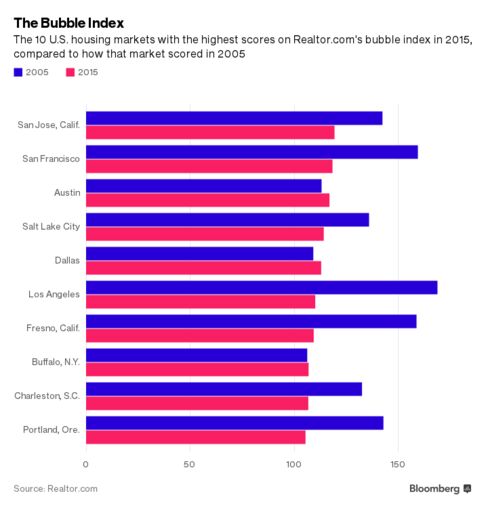
Last year, only six metro areas exceeded the benchmark by 10 percent, with San Jose coming in highest, at 19 percent above 2001 levels. In 2005, there were 29 cities that were at least that bubbly, as the chart below shows:
The local markets that look the most like a bubble are, unsurprisingly, places where population is growing faster than housing supply. That includes California cities where zoning regulations have slowed or prevented new construction, as well as Texas markets in which rising land and labor costs, and some lingering aftershocks from the bust, have held back housing starts. Meanwhile, the share of U.S. households that rent is near 50-year highs, helping to drive up rental prices and giving investors across the country incentive to snatch up for-sale homes.  
Prices in Austin and the San Francisco Bay Area, among other places, are probably unsustainable, Smoke said. That could be bad for buyers who get in at the top of the market and bad for the local economy if high housing costs spur talented workers to move away. “We could have a housing cost-induced economic slowdown because people can’t make the housing market work,” Smoke said.
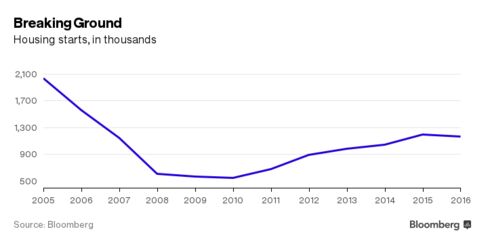
Figuring out how to create enough new housing to meet demand is a tricky question. In one scenario sketched out by Smoke, faster economic growth would lead to higher interest rates, leading banks to lend more easily to homebuyers. In another, a bad economy could slow household growth, dampening demand. Right now, builders are starting new homes at a modest clip despite significant demand, probably because the cost of building them outweigh the prices homes are fetching. “If you were a builder and you could do it, wouldn’t you?” Smoke asked.

The current housing market isn’t without some pockets of speculation, said Daren Blomquist, senior vice president at RealtyTrac. A rule of thumb for investors who flip homes is to buy at a 30 percent discount to the local market, he said. That leaves room to fix up the house and sell at a profit. In the first quarter of 2016, flippers in Denver were buying at a 14 percent discount to market prices, and flippers in Orange County, Calif., were buying at an 11 percent discount.
“They’re riding the wave of rising home prices,” Blomquist said. “They’re not buying low—they’re hoping that they can sell high.”

Tuesday, July 19, 2016

How Social Media Helped Defeat the Turkish Coup (BW)


The attempted coup d'etat by a faction of Turkey's armed forces on Friday failed for many reasons, including divisions among the military and repeated missteps by the plotters.

Social media and mobile communications also played an important role. And it wasn't the first time this combination has enabled citizens to express their will and have a say in deciding who governs them and why.

Judging from available information, the rebellious faction of mid-level army officers sought to implement the classic playbook for military takeovers -- what in the old days would have been labeled a "colonels' coup," as opposed to one led by generals. They closed key transportation routes, tried to secure both parliament and the presidential offices, and attempted to capture high-ranking officials, including President Recep Tayyip Erdogan and top military brass. They also took over state media outlets, and used state television to broadcast their message and prematurely declare victory.

The instigators soon realized that this classic approach was not sufficient, and moved to take control of private television channels, even shutting down the Turkish affiliate of CNN, an event that was broadcast live around the world.

The objective was conventional: By denying citizens access to alternative sources of news, the rebels would be able to control the narrative, dictating the information that was going out and its interpretation. They would also use this control to energize their small group of collaborators and attempt to persuade others to join them, particularly other factions of the military.

But the putschists failed to sufficiently update the standard coup playbook to take into account the realities of social media and mobile technology. As a result, their attempt to control the information available to ordinary citizens was only partial and the military's message was soon drowned out by domestic and international news outlets with much greater powers of amplification. Then, the advantage the military had initially gained through the element of surprise quickly eroded.

Within hours of the beginning of the coup, Erdogan used the video capability on his mobile phone to communicate with the nation, urging Turks to take to the streets and stand up to the rebels. His message was amplified on social media channels, such as Facebook and Twitter, and supplemented by images of people standing in front of tanks and on top of them. 

Social media also played a critical role in relaying -- in real time -- domestic and international support for the president and for Turkey's democratically and legitimately elected government. These messages came from some of Erdogan's internal political critics, too, who used Twitter to condemn the attempted coup, which they said wouldn't bring the right kind of change. 

Foreign leaders, including President Barack Obama, echoed the support for Turkish democracy and for Erdogan. 

The international and domestic engagement did more than simply feed the curiosity of ordinary Turkish citizens. It countered the certainty about the outcome that the small group of officers in control of state media and some key installations had tried to convey. It also undermined the coup plotters' attempts to convey a state of siege. The flow of information encouraged, empowered and mobilized Turks to confront the rebels and their tanks.

The population went from being passive recipients to proactive participants in the country's present and future. And by challenging the information being transmitted by the captured media sources, they prevented the small group of mid-level officers from turning pre-emptive claims of victory into reality.

A significant number of Turks collectively formed what advancing military forces fear most -- crowds of civilians blocking their path and complicating their operational plans. The strength of the people was transmitted both domestically and internationally through images on social media of civilians standing up to rebel soldiers in the streets. This signaled that the rebels were not winning, and diminished the chances that they would ultimately prevail.

Sensing defeat, hundreds of rebellious soldiers started surrendering and road blockades were lifted. The images that filled social media showed that citizens had again found a way to have a deterministic role in their political destiny -- particularly when it comes to how they are governed and by whom.

This is not the first time that social media and mobility played an important role in influencing outcomes, or allowed ordinary citizens to play a greater part in ensuring that a tiny minority is unable to impose its will on the majority. And it is not the first time that the will of the people prevailed with the help of technology. For example, in 2011 and 2013, millions of ordinary Egyptians, enabled by social media, stunned the world with their collective action, taking to the streets to influence how they would be governed.

In helping to foil a coup against a legitimately elected government, social media reinforced democracy. This is the flip side of the tragic use of this same technology to influence and radicalize the disenfranchised.

History will record that the rogue Turkish officers and their followers failed to understand how social media has changed the traditional dynamics of military coup d'etats. It contributed to avoiding an outcome that, at a minimum, would have created huge uncertainty in one of the largest European countries and a member of NATO. That would have been yet another development that "expert opinion," both in the public and private sectors, had not predicted. Now the challenge for Turkey is to ensure that the legacy of the failed coup will be the strengthening of the country's democracy and its legitimate institutions.

This column does not necessarily reflect the opinion of the editorial board or Bloomberg LP and its owners.

Monday, July 18, 2016

Tesla Autopilot Too Much, Too Soon,

Consumer Reports Warns:
The bible of American commerce says the feature gives drivers a "false sense of security."

In an unusual move, Consumer Reports has called Tesla's Autopilot "Too Much Autonomy Too Soon" and called on the automaker to disable the hands-free feature until its safety can be improved. The system has come under increased scrutiny in the wake of a fatal May 7 crash in Florida, which U.S. safety regulators are investigating.

"By marketing their feature as 'Autopilot,' Tesla gives consumers a false sense of security," said Laura MacCleery, vice president of consumer policy and mobilization forConsumer Reports, in the article published Thursday. The article continues: 

"In the long run, advanced active safety technologies in vehicles could make our roads safer. But today, we're deeply concerned that consumers are being sold a pile of promises about unproven technology. 'Autopilot' can't actually drive the car, yet it allows consumers to have their hands off the steering wheel for minutes at a time. Tesla should disable automatic steering in its cars until it updates the program to verify that the driver's hands are on the wheel."
More than 70,000 Tesla cars are equipped with Autopilot worldwide, and drivers must actively choose to engage the system. In a blog post about the Florida accident, Tesla stressed that those cars have driven more than 130 million miles while using the feature, giving Tesla valuable data in real-world driving conditions. Some customers see the system as an enormous asset during grueling commutes, but YouTube is also filled with videos of people taking risks with it. 
"Tesla is consistently introducing enhancements proven over millions of miles of internal testing to ensure that drivers supported by Autopilot remain safer than those operating without assistance," said Tesla in a statement Thursday. "We will continue to develop, validate, and release those enhancements as the technology grows. While we appreciate well-meaning advice from any individual or group, we make our decisions on the basis of real-world data, not speculation by media."

And don't expect Tesla Chief Executive Officer Elon Musk to heed the call for a name change. Tesla has always said that Autopilot "functions like the systems that airplane pilots use when conditions are clear. The driver is still responsible for, and ultimately in control of, the car."

Friday, July 15, 2016

The Housing Market Is Waving a Red Flag

Third-party investors are making up an alarmingly high share of auction purchases, according to housing-data firm RealtyTrac

1468441458_m490992
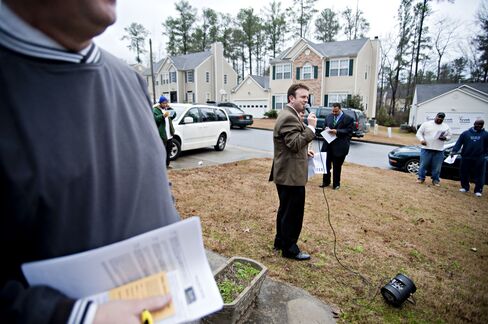
An auctioneer speaks to potential bidders outside a home in Atlanta.

Almost nine years after the housing-market bust helped trigger the most recent recession, RealtyTrac senior vice president Daren Blomquist sees the industry waving a red flag.

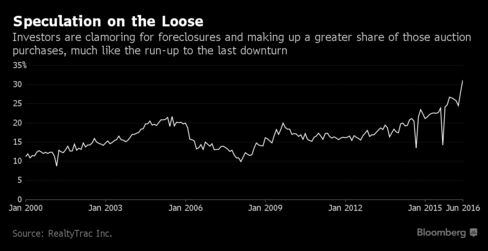
The same fervent speculation that abetted the housing bubble is showing up in the bloated share of foreclosures snapped up by third-party investors at auction — a record 31 percent in June, according to RealtyTrac data that starts in 2000.

Many of those third-party buyers are "mom and pop" investors with less experience, said Blomquist. At the same time, institutional investors, a subset of the third-party investors who purchase at least 10 properties a year, are ducking out of the market.

"It's somewhat counterintuitive — as the market gets better and there are fewer foreclosures available, demand for those good deals, those bargains in the market goes up," said Blomquist. "When you see this high percentage of the properties going to third-party investors, that is a sign that these speculators may be over-inflating the market."

The third-party investors are gaining a bigger share of a shrinking pie, as foreclosure auctions made up 8 percent of all home sales in June, the lowest since August 2006.

Meanwhile, institutional buyers made up about 38 percent of those investor purchases at foreclosure auctions in June, down from a steady trend of around 50 percent in the first five years of the expansion, the data show. They accounted for 2.5 percent of all home purchases in June, down from a peak of 9.8 percent in February 2013.

The same kind of decline in institutional buyers was a dramatic harbinger of the last downturn as more seasoned stakeholders headed for the sidelines.

"Their analytics are telling them it's not a good time to buy — that's definitely another red flag that they're pulling back at the same time as the less savvy investors are ramping up," he said.

And while investors at foreclosure auctions could rely on about a 40 percent discount from the previous sales price in the early years of the expansion, this year they're only garnering about a 30 percent markdown, Blomquist said.

"The pressure is building in the pressure cooker, and at some point that's going to need to be released," Blomquist said. There's a little time — "probably not in the next month or two but in the next couple of years," a downturn should set in, he said.

Overall, the housing market looks great so the latest data showing a rise in speculation by non-professional investors was an early warning signal, Blomquist said. "Real estate is cyclical — it's not this steady trend upward."


Thursday, July 14, 2016

FTC : Against Ohio Auto Dealers regarding Lease Terms

FTC@100 Banner

Following a public comment period, the Federal Trade Commission has approved a final consent order against Progressive Chevrolet Company and Progressive Motors Inc., of Massillon, Ohio, which the FTC charged with deceiving consumers by using advertising that touted low monthly car lease payments and down payments but failed to disclose other key terms of the offers.

In November 2015, Progressive Chevrolet Company and Progressive Motors Inc. agreed to settle FTC charges that they failed to properly disclose terms such as credit score requirements and the fact that the payment does not include tax, title, and fees.

The consent order, prohibits the dealers from advertising the amount of any monthly payment, down payment, or other payment, unless they clearly and conspicuously disclose all qualifications or restrictions on a consumer’s ability to obtain the advertised terms. If the ad states that consumers must meet a certain credit score in order to qualify for the offer and a majority of consumers are not likely to meet the stated credit score, the ad must clearly and conspicuously disclose that fact.

The dealers also are barred from misrepresenting the cost of buying or leasing a vehicle, or misrepresenting any other material fact about the price, sale, financing, or leasing of any vehicle. In addition, they are prohibited from advertising a payment amount, or that any or no initial payment is required at lease inception, without clearly disclosing other key terms.

The Commission vote approving the final consent order and a letter to the one commenter was 3-0.

The Federal Trade Commission works to promote competition, and protect and educate consumers. You can learn more about consumer topics and file a consumer complaint online or by calling 1-877-FTC-HELP (382-4357). Like the FTC on Facebook, follow us on Twitter, read our blogs and subscribe to press releases for the latest FTC news and resources.

Contact Information

MEDIA CONTACT:
Frank Dorman,
Office of Public Affairs
202-326-2674

STAFF CONTACT:
Michael B. Rose and Jon Kessler
FTC’s East Central Region
216-263-3455

Related Cases

More news from the FTC >>
Facebook YouTube Twitter

SUBSCRIBER SERVICES:  Manage Preferences  |  Unsubscribe  |  Help

This is a free service provided by the Federal Trade Commission.

Wednesday, July 13, 2016

Will a Camera on Every Cop Make Everyone Safer? Taser Thinks So

How the stun-gun maker plans to monopolize the body cam market.
1468290787_feat_taser30_04
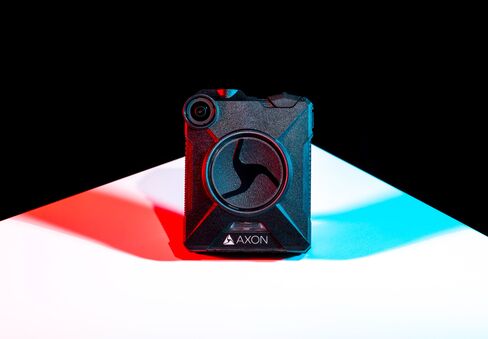
Axon Body 2 camera by Taser. 

On Aug. 9, 2014, in Ferguson, Mo., a white police officer shot and killed an unarmed black teenager named Michael Brown. Several witnesses described the shooting—which wasn’t captured on video—as unprovoked. In the national furor over police violence that followed, one remedy found common support across much of the political spectrum: outfitting more cops with body-mounted cameras to deter misconduct and create a record of tragic encounters. When a grand jury decided that November not to charge the officer in Ferguson, the victim’s family pushed “to ensure that every police officer working the streets in this country wears a body camera.” The White House proposed $75 million in matching funds for state and local police to buy the devices.

A few months later, in January 2015, employees of Taser International, the maker of stun guns, gathered for a sales meeting at the company’s futuristic headquarters in Scottsdale, Ariz. They filled the ground floor and lined the catwalks that crisscross the three-story atrium, a space where a lightsaber duel wouldn’t seem out of place. Shades blocked out the desert sun, and in the darkness, low, long trumpet sounds blared—the famous Richard Strauss theme used in 2001: A Space Odyssey.

As the sound of the timpani—boom boom boom boom boom boom—kicked in, Rick Smith, Taser’s chief executive officer, appeared high up among the rafters, dangling in a harness on a thin wire. He descended slowly, brandishing a giant yellow triangle: the logo for Axon, a recently expanded line of Taser body cameras and related tools. “Woooooo!” he shouted as he landed, pumping his fist in the air. The staff erupted in cheers and whistles as he lifted the logo triumphantly over his head. “Axon! Axon!” the group chanted.

Smith, 46, has intense round eyes that never seem to blink and floppy dark hair that channels Joey from early episodes of Friends. He’s often seen around the office in jeans, a Taser-branded shirt, and Taser-branded sneakers, with a Taser-branded Bluetooth headset wrapped around his neck—a get-up that echoes how ubiquitous the company’s black-and-yellow sidearms have become in law enforcement. When I ask for statistics on market share, Chief Financial Officer Dan Behrendt says he’s “comfortable saying that almost 100 percent of the CEWs”—conducted electrical weapons—“in use in North America have been supplied by us.”

When he co-founded Taser in 1993, Smith says his goal was “making the bullet obsolete.” The war on drugs and the 1992 Rodney King riots in Los Angeles had led Americans to reconsider how lethal they wanted their police departments to be. Taser’s breakthrough product, a pistol-shaped device that uses electricity to incapacitate a target, made the company worth more than $1 billion by 2004. But with market saturation came personal-injury and wrongful-death lawsuits; for almost a decade, Taser’s stock languished. The “Ferguson incident,” as the company refers to it, gave it a chance to grow again. By the next summer, with its shares at a record high, Taser executives were telling investors that thanks to body cameras, “2015 is our Super Bowl.”

Cop cams are inextricably tied to Taser, by far the dominant supplier, and the company will likely shape whatever the devices evolve into. For Taser, the cameras are more than just a new product category. Founded at one national moment of police angst, the company is using another such moment to transform from a manufacturer into a technology company. From a business perspective, body cameras are low-margin hunks of plastic designed to get police departments using the real moneymaker: Evidence.com, which provides the software and cloud services for managing all the footage the devices generate. Taser markets these tools under the Axon brand. About 4.6 petabytes of video have been uploaded to the platform, an amount comparable to Netflix’s entire streaming catalog. All of it must be preserved to an evidentiary standard. The company can sell a weapon or camera once, but cloud services are billed year after year.

“Taser wants to be the Tesla or Apple of law enforcement,” says Hadi Partovi, a venture capitalist who sits on the board. There are early signs the effort is working. In the first quarter of 2016, for the first time, Taser’s bookings for future revenue from the cameras and cloud services, $52 million, surpassed revenue from weapons sales. Every time a controversial police killing occurs—most recently with the July 6 death of Philando Castile in Falcon Heights, Minn.—there’s more pressure to outfit cops with cameras. And those cameras generate footage that will wind through the court system for years.

The officer who shot Castile wasn’t wearing a camera; Castile’s girlfriend used her phone to post live footage of the immediate aftermath to Facebook. The scene “looks terrible, and it’s hard not to conclude it is terrible,” Smith says. “We look at that and say if that [officer] had a camera on, we would at least have some idea if there was any justification for what happened.” Situations where witnesses have cameras but police don’t are “maybe the worst of both worlds,” he says. “You get all of the bad and none of the potential good, at least from the law enforcement perspective. You are missing the most critical elements to determine if it’s abusive or reasonable.” After the Castile footage went viral, demonstrators gathered for a march in Dallas, where a U.S. Army Reserve veteran ambushed and killed five law enforcement officers. “One incident somewhere can affect police officers around the world,” Smith says.

Dallas is an Axon customer: Last year the police there signed a $3.7 million contract to buy 1,000 Evidence.com subscriptions and cameras, some of which are already in use. “This will enhance our opportunity to document critical incidents; it will enhance officer safety; it will enhance courtroom testimony, which we think will turn into more convictions,” the city’s deputy police chief, Andrew Acord, told a local public radio station at the time.

Body cameras are too new for anyone to say how they’ll change policing. Early studies show that officers who wear them use force less frequently and face fewer citizen complaints—and that the footage may increase conviction rates and guilty pleas in prosecuting crimes. The results from one of the largest controlled studies in the U.S., at the Las Vegas Metropolitan Police Department, are due this fall.

Before setting out on patrol one day in March, Las Vegas police officer Sal Mascoli makes an inventory of his weapons. “Write down my badge number,” he says, in case something goes wrong. “P number five-one-one-five.” In a bracing New York accent, Mascoli points out where he hides a knife on his khaki uniform, where the rifles are stored in his SUV, and how to release his pistol. There’s a Taser stun gun strapped toward the back of his belt. Peeking above the collar of his crisp shirt is an Axon camera the size of a lipstick tube.

Mascoli is a cop’s cop, with short, close-cropped hair and a never-ending squint. He’s worked for Metro for two decades, after first serving in the U.S. Marines, and he’s trained hundreds of his colleagues in hand-to-hand combat. Out on patrol, he’s stern but affable. At a gas station, a lanky young man in hipster glasses flags Mascoli down. A driver just tried to run him over in a crosswalk, he says. Mascoli can’t do much about that, but he chats up the citizen—giving a young black man a good vibe about cops never hurts, he says later. The guy says he’s a comedian from Harlem looking for work. “I’m from Queens!” Mascoli says, as if his accent didn’t give him away. “I’m all Italian, all the time.” Mascoli hands out his phone number, recommends a comedy club with an open mic night, and rolls on.

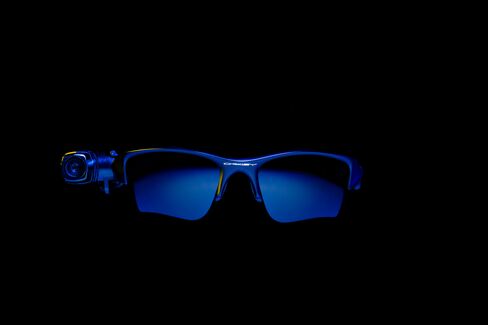
The Axon Flex camera, which can attach to sunglasses or a collar, connects via wire to a battery pack that's usually worn on a belt or in a shirt pocket.
The Axon Flex camera, which can attach to sunglasses or a collar, connects via wire to a battery pack that's usually worn on a belt or in a shirt pocket

Soon, a scraggly, middle-aged white man pushing a shopping cart catches his eye. Did he throw something over that fence? Mascoli pulls a U-turn and, almost imperceptibly, taps his chest. Two quiet beeps signal that he’s activated the Axon. He gets out of his SUV, pats down the suspect, and finds a long kitchen knife tucked in the man’s jeans. “You’re losing your knife today, you know that, right?” Mascoli says. He runs the man’s priors. “Eighty-four times you’ve been arrested, brother, and you ain’t learning,” he says. He sends the man on his way—no arrest.

Mascoli tosses the knife into his SUV, speaks into the camera to say the recording is ending, and taps the body cam. When his shift is over, he’ll dock his camera at the station to transmit the footage to Evidence.com. As he drives toward a burglary alarm, Mascoli says he doesn’t care for Taser weapons, but he’s made a bet on the business of cop cams. When the department issued him his Axon, he bought 25 shares of Taser stock. Mascoli likes wearing the camera, because it provides a balance to the citizen footage, from Facebook Live streaming to smartphone video, that increasingly monitors policing around the country. “I wanted my perception to be portrayed instead of someone else pulling out a camera phone and putting out a 10-second snippet,” he says. As his stubby fingers hunt and peck on the new dispatch computer installed in his police car, he groans, “I’m so bad at technology.” But with the camera, “I want to be on the early edge,” he says. “I know it’s coming.”

Taser initially turned to cameras as a way to ward off lawsuits, both for the company and the police. “It was about defending our business,” Smith says. As police departments across the U.S. discovered Taser in the early 2000s and bought into the idea that cops armed with a stun gun might reach for their Glock less often, the company saw explosive growth: Sales increased sixfold from 2002 to 2004. That brought scrutiny and charges that the company’s products were more dangerous than advertised. In 2004, Amnesty International published a report tallying more than 70 people who’d died after being shocked, either during the event or shortly afterward. (The group’s 2012 report says that number has risen to more than 500.) Dozens of plaintiffs have sued over injuries and deaths. Taser has prevailed in most of the cases, but in 2009 it revised its product warnings to say exposure in the chest area could cause cardiac arrest. The Securities and Exchange Commission investigated Taser’s safety claims in 2005 and eventually closed the case without an enforcement action

In 2006 the company started selling the Taser Cam, a $400 clip-on device that automatically begins recording when an officer engages the stun gun. Street cops were skeptical. Smith likens it to the early hesitancy about dashboard cameras in squad cars—many officers dislike feeling as if they’re under constant surveillance. Few departments adopted Taser Cams. For those that did, it didn’t help Taser’s image that the device captured only the final moments of a conflict. Smith says, “You ended up with a highlight reel of people getting Tased.”

Taser International CEO Smith.

The few agencies that used Taser Cams gave the company a glimpse of an unexpected problem. Even large departments with ample resources struggled to download and preserve the video clips. As Taser began to develop a standalone body camera, one that could record long encounters or an entire patrol shift, it realized it needed to create a system to manage a new scale of footage.

Body camera footage is already starting to enter the court system. Tim Fattig, the chief deputy district attorney in Clark County, which includes Las Vegas, estimates that about 20 percent to 25 percent of his cases have video evidence from the devices. Much of the footage is banal, but some can be helpful, he says. One recent trial involved a traffic stop that turned into a high-speed chase after a suspect fired a gun into the air and ambushed an officer. “It brought to life the officer’s perspective to the jury,” Fattig says. “They saw this all happened within a couple of minutes. It went from a minor traffic thing to life and death.” The defense challenged the footage, saying the suspect wasn’t identifiable in the recording and the gunshots weren’t audible, but the suspect was convicted and sentenced to as much as 157 years in prison.

Other Las Vegas cases show that body cameras aren’t the panacea that transparency advocates may be hoping for. The police department regularly releases body camera footage within three days of an officer-involved shooting, a practice praised by the American Civil Liberties Union. So far, none has caused a major uproar. But there’s one video, whose contents are almost certainly inflammatory, that the department hasn’t released. At 5 a.m. on Jan. 6, 2015, Officer Richard Scavone saw a woman named Amanda Ortiz drinking a cup of coffee in the parking lot of an area police say is popular for prostitution. According to a federal indictment, Scavone handcuffed Ortiz, then beat her, throwing her to the ground, striking her, and slamming her face into his patrol car several times.

The Justice Department charged Scavone with violating Ortiz’s civil rights and falsifying his report. He contests the charges. Although his camera captured the whole incident, Metro won’t release the footage, saying it’s part of an ongoing investigation. “We are not going to release evidence in this case,” Lieutenant Zehnder says. “Some people say, ‘We want to see it.’ You don’t get to. … It will come out in court.”

In Las Vegas alone, police have uploaded more than 16 terabytes of video to Evidence.com; that will likely pass 30 terabytes by yearend, Zehnder says. Combined with footage from other cities, it’s an unprecedented trove of interactions between police officers and the citizens they serve. What Taser does with all that data may shape the company’s—and policing’s—future.
“We’ve kind of leveraged a weapon to introduce a camera, and we’ve leveraged the camera to introduce Evidence.com,” Larson says. “This is really, really awesome, because no one else in the world is going to capture the data that we capture.” The company may explore license plate recognition, automated transcription of dialogue, and other feats of machine learning. “I mean, the possibilities are endless,” Larson says.

From where Zehnder sits, it’s obvious that big data is the next frontier for Taser and policing. “Some of it is very Orwellian and very scary and will rattle the cages of civil libertarians around the country, but it’s coming,” he says. Zehnder riffs on how facial-recognition technology might be deployed: An officer could patrol the Las Vegas Strip with a camera streaming to the cloud, “and there is real-time analysis, and then in my earpiece there is, ‘Hey, that guy you just passed 20 feet ago has an outstanding warrant.’ Wow.”

Smith says Taser plans to roll out live-streaming capabilities in 2017, and he expects facial recognition to become a reality someday so agencies can query police records or social networks in real time. “If we think about that situation in Minnesota, maybe that officer did have some preconceptions [about Castile], and maybe they were unhelpful preconceptions,” Smith says. If the officer had known that Castile didn’t have a violent police record, as has been reported, his death might have been averted. “The more we can help reduce that uncertainty, the better,” Smith says.

In Las Vegas, Professor Sousa is still crunching the data from the study on whether cop cams lead to better policing. Early results indicate some improvement, but Sousa warns against expecting too much from mere electronics. “The technology is being sold very strongly as a means to improve trust and enhance legitimacy, and I worry about tossing around those terms too loosely,” he says. While body cameras provide transparency and have come to represent the hopes of restoring faith in policing, Sousa says, “it is asking a lot of the technology to do that, especially in a really short period of time.”