Wednesday, May 18, 2016

EN MI OPINION (Por: Ricardo Tribín Acosta)


A Cappella

A Cappella, en música, es un estilo muy particular en el que un cantante no se acompaña de instrumento musical alguno cuando interpreta una melodía y al hacerlo de tal forma está dando rienda suelta solamente a su talento artístico y a la capacidad de sus cuerdas vocales.

 En la vida también suceden actos  “A Cappella”, en los que el ejecutante muestra sus habilidades sin contar apoyo externo, lo cual tiene cosas positivas aunque en ello puede florecer paralelamente una actitud algo egocéntrica.
  
Juntos podemos, dice una expresión en la que el grupo logra lo que a un solo individuo le queda muy difícil e, incluso a ratos,  casi que imposible. De ahí que Los tres Mosqueteros de la célebre obra de Alejandro Dumas, inmortalizaran la frase “Uno para todos y todos para uno”.

 Por ello, cuando todo parezca nada, resulta bueno volver a empezar, contando con ayuda externa la cual , sin duda alguna, si proviene de un Poder Superior, se convertirá en un magnifico soporte maximizado hasta su límite más alto cuando a ella se invoca con una definitiva creencia en que El funcionará.


Miami, Mayo 11 de 2016


Tuesday, May 17, 2016

‘I’ll Never Retire’: Americans Break Record for Working Past 65

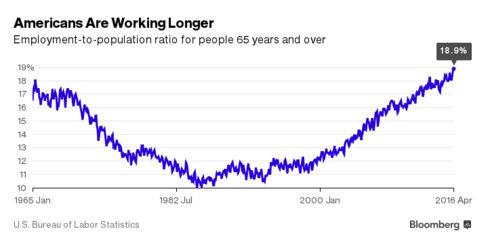
Four charts tell the story.
Almost 20 percent of Americans 65 and older are now working, according to the latest data from the U.S. Bureau of Labor Statistics. That’s the most older people with a job since the early 1960s, before the U.S. enacted Medicare.
Because of the huge baby boom generation that is just now hitting retirement age, the U.S. has the largest number of older workers ever.
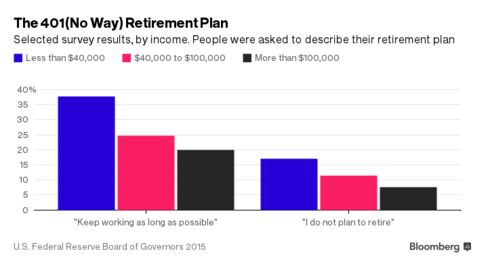
When asked to describe their plans for retirement, 27 percent of Americans said they will “keep working as long as possible,” a 2015 Federal Reserve study found. Another 12 percent said they don’t plan to retire at all.
Why are more people putting off retirement? 
They need the money
Three in five retirees surveyed by the Transamerica Center for Retirement Studies said making money or earning benefits was at least one reason they had retired later than they planned to. Almost half said financial problems were their main reason for working past 65.

The financial crisis, and the tech bust before it, devastated many baby boomers' retirement savings. That's if they had any to begin with. Today, 60 percent of U.S. households have no money in a 401(k) or similar retirement account, and the benefits of 401(k)s are skewed toward the wealthiest Americans, a recent report by the Government Accountability Office found.


The waning of traditional, defined-benefit pensions could also be delaying retirement, even for wealthier Americans. Instead of getting a monthly check, many retirees end up with a pot of 401(k) assets they’re not sure how they should be spending. The ups and downs of the market can heighten their anxiety and keep them going into the office.

They like their jobs

Thirty-six percent of respondents told Transamerica they had worked past 65 mainly because they enjoy their jobs or “want to stay involved.”

Education probably comes into play here. People with college and graduate degrees tend to work later than those with less schooling, according to a 2013 study by the Center for Retirement Research at Boston College. And since 1985, the share of older Americans with college degrees has tripled, to about a third of 60- to 74-year-olds.

Employers want (some) older workers to stick around

With the U.S. unemployment rate at 5 percent, the lowest since 2008, employers have a greater incentive to keep older workers happy. They might not be able to replace them.

With more education, these skilled, experienced workers have become more valuable to employers. In 1985, workers tended to earn the highest salaries of their careers in their 40s, the Center for Retirement Research study found. By 2010, those peak earning years had shifted from the 40s to the 50s. All age groups older than 50 earned more than they did 25 years earlier, with those in their late 60s making 30 percent more. Workers under 50 earned less than they used to.

Older Americans are healthier and living longer

At last, many Americans have more time to do what they want to do. With a rise in average life expectancy, a longer career doesn’t necessarily mean a shorter retirement.
Wealthy, educated people have gotten the biggest boost to their longevity, but even the least-educated Americans are getting a few more years than their parents did three decades ago.

There’s some evidence that working can actually improve the health of older people, though studies have also found the opposite. A February study of U.S. factory workers found that retirement was good for their health. 

Or maybe retirement just isn’t as much fun

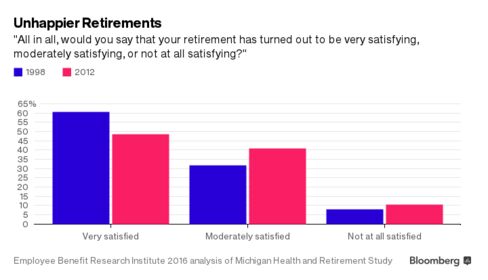
It’s hard to explain why Americans might be enjoying their golden years less, but that's what a study last month by the Employee Benefit Research Institute found.


Maybe it's self-perpetuating, a result of peer pressure. It has become increasingly normal to be over 65 and working, as more and more boomers reach retirement age, said Torsten Sløk, chief international economist at Deutsche Bank. Now that one in five older Americans has a job, he says, “I would think this just continues to move higher.”

Monday, May 16, 2016

Say Goodbye to OPEC, States Oil Exec

OPEC PRODUCTION LEVEL
Internal differences are killing OPEC and its ability to influence the markets has all but evaporated, top Russian oil executive Igor Sechin told Reuters in some of his harshest remarks ever about the oil cartel.

Russia, which has been hit hard by the oil price collapse, was flirting with the idea of cooperating with OPEC in recent months until tensions between OPEC members Saudi Arabia and Iran ruined a global deal to freeze output.

Sechin – one of the closest allies of President Vladimir Putin – was the only Russian official to consistently oppose the deal with OPEC even after the Kremlin effectively endorsed the plan.

Now that his gloomy predictions about talking to OPEC have come to pass, Sechin feels vindicated and wants to help Russia avoid similar embarrassment in future.

“At the moment a number of objective factors exclude the possibility for any cartels to dictate their will to the market. … As for OPEC, it has practically stopped existing as a united organization.”

“The company (Rosneft) was skeptical from the very beginning about the possibility of reaching any sort of joint agreement with OPEC’s involvement in current conditions,” said Sechin, in comments over the weekend which were embargoed until Tuesday.

“Just to remind you, the only one question with which we responded to those who were interested to know our position: ‘Who should we agree with, and how?’ The development of the situation has clearly shown we were right.”

Sechin’s comments about the end of the era when OPEC could influence prices chime with those of Saudi Arabia’s newly appointed energy minister Khaled al-Falih.

Falih, who took over on Saturday from long-serving Ali al-Naimi, has been very vocal in the past year about his views that the oil market needs to rebalance through low prices and that the Saudis have the resources to wait.

Falih’s ultimate boss, Deputy Crown Prince Mohammed bin Salman, who oversees Saudi oil policies, has also signaled that the world is moving to a new era where supply and demand rather than OPEC will determine prices.

Sechin, who was born in 1960 – the same year as Falih – is also calling on Russia to abandon any hope that prices can be fixed by anything other than market rebalancing.

“At the moment, key factors which are influencing the market are finance, technology and regulation. We can see this with the example of shale oil which … became a powerful tool of influence on the global market,” Sechin said in the emailed comments. 

Friday, May 13, 2016

The Six-Hour Workday Works in Europe. What About America?

A study shows employees get sick less, have lower stress, and work harder. Still, applying the idea in the U.S. won't be easy.

For about a year, nurses at the Svartedalens retirement home have worked six-hour days on an eight-hour salary. They're part of an experiment funded by the Swedish government to see if a shorter workday can increase productivity. The conclusion? It does. 

As with any cultural shift in the workplace, the six-hour day has to prove itself more than just humane. For any employer, in Sweden or elsewhere (and perhaps especially in the U.S.), an abridged workweek can't damage productivity if it's going to have a chance.

A year's worth of data from the project, which compares staff at Svartedalens with a control group at a similar facility, showed that 68 nurses who worked six hour days took half as much sick time as those in the control group. And they were 2.8 times less likely to take any time off in a two-week period, said Bengt Lorentzon, a researcher on the project.  

"If the nurses are at work more time and are more healthy, this means that the continuity at the residence has increased," Lorentzon said. "That means higher quality [care]." Less surprising was that the nurses were 20 percent happier and had more energy at work and in their spare time. This allowed them to do 64 percent more activities with elderly residents, one of the metrics researchers used to measure productivity. 

Svartedalens is part of a small but growing movement in Europe. Sweden has dabbled with shorter workdays before: From 1989 to 2005, home-care-services workers in one Swedish municipality had a six-hour work day, but it was abolished due to a lack of data proving its worth. The Svartedalens experiment is designed to avoid that problem: "This trial is very, very clean because it's just one homogenous group of workers," said Lorentzon. In Sweden's private sector, the practice is taking root in places such as Toyota service centers in Gothenburg. In the U.K., a marketing agency adopted a staggered schedule to allow for reduced work hours while ensuring coverage; a survey last month found that six out of 10 bosses in that country agreed that cutting hours would improve productivity. 

The key result of the Swedish study—that productivity can increase with fewer hours worked—eliminates a major stumbling block to globalizing the shorter work day. "The six-hour work day has not been well accepted in many countries because organizations are worried their productivity might fall," said Pramila Rao, an associate professor of human resource management at Marymount University.

Even with encouraging results, it's unlikely that the U.S. will soon shift to shorter days. Americans work around 38.6 hours per week, according to the Organization for Economic Cooperation and Development. They get, on average, fewer than eight paid vacation days a year; only about three-quarters of workers get any paid time off at all, according to the U.S. Bureau of Labor and Statistics. "The Swedish model will not be easily accepted in the U.S. because we are a nation of workaholics," said Rao.

"In many companies today, you still see that mentality that you have to be in the office," added Carol Sladek, work-life consulting lead at Aon Hewitt LLC. "Reducing the workday is very foreign to our overall values."

John Maynard Keynes didn't think so. He famously predicted that technological progress would lead us to shorter weeks and abundant leisure time; a 15 hour workweek should be the norm by 2030, he prognosticated. The prophecy was echoed by Herman Kahn, who in the 1960s said Americans would one day have 13 weeks of vacation and a four-day work week. That's definitely not the reality in 2016 America. 

The Swedish study isn't the first that made a connection between happier, rested workers and better outcomes for employers. Any link between hours worked and productivity was shown to be weak in a 2014 paper from Stanford University. The research found a "non-linear" relationship between hours worked and output: Results start to slide around the 50-hour-per-week mark. In fact, too much work can damage productivity. People who feel overworked said they make more mistakes at work, according to a study by the Families and Work Institute.

While the Svartedalens experiment offers evidence that shorter hours improve productivity, nursing as an occupation may be more analogous to that of medical residents, rather than a desk job. The study equates productivity with quality of care, which doesn't necessarily translate to white-collar work. 

Then there's the math problem. Cutting worker hours can cost employers money if increased productivity saves less than the cost of hiring additional workers. Svartedalens had to hire an additional 15 nurses, which cost 6,000,000 Swedish krona (about $735,000). 

About half of that expense was offset by the decrease in sick days and time off. That said, the experiment didn't measure how the improved care affected the overall bottom line.
  
In the U.S., companies have sought to show flexibility by adopting a four-day workweek, albeit with the same total amount of hours. In a sort of workplace sleight-of-hand, the prospect of perpetual long weekends keeps people motivated. "It helps them stay more focused," said Rao.

About 30 percent of 1,060 employers surveyed by Aon Hewitt offer a compressed workweek. Almost 60 percent of organizations that were surveyed offer flextime, which allows people to decide what time they arrive and leave. Research has found that workers who have control over their schedules report lower levels of stress, burnout, and higher job satisfaction. 

"Employees would rather have more time off, but absent that, giving a little control is a good substitute," said Sladek. "We're like toddlers: As long as we have control over our environment, we feel good." 

Thursday, May 12, 2016

The Fingerprint Lock on Your Phone Isn’t Cop-Proof


Law enforcement has an end run around smartphone encryption. For now.

The FBI’s feud with Apple over access to Syed Farook’s iPhone might never have happened if the San Bernardino, Calif., shooter had been carrying a 5S or newer. For the 250 million phones sold around the world with fingerprint authentication since 2013, law enforcement may be able to compel suspects to press their fingers to the devices and unlock them.

With minimal litigation on the books in the U.S., police and prosecutors require only a judge’s blessing on a warrant for a suspect’s fingerprints. So far they’ve used the power sparingly. But as the number of fingerprint scanners in hip pockets grows, district attorneys across the country say the technology is poised to become a major engine of evidence-gathering. “It is likely to be just a matter of time till this does become a primary gateway to accessing phones,” says Micheal O’Connor, an Alameda County assistant district attorney in Oakland, Calif.

If a person has enabled Apple’s Touch ID, her fingerprint will unlock the phone for 48 hours after locking before the device requires a PIN. Systems on newish Samsung and LG phones work similarly. Los Angeles and Oakland are among the cities that have already granted or received warrants for the use of a finger to unlock a phone. The next step may be a lawsuit that determines whether a fingerprint is off-limits.

Legal scholars say law enforcement is likely to win that fight. Two years ago, David Baust, a paramedic in Virginia Beach, Va., admitted that his locked iPhone 5S may have filmed him in bed strangling his girlfriend, according to a court filing. Baust’s lawyers argued that unlocking the phone would violate his Fifth Amendment right to avoid incriminating himself. 

A state judge ruled that demanding Baust type in his pass code would entail a “mental process” leading to self-incrimination, but that asking for his fingerprint was more like drawing a blood sample and therefore OK.

Although the Virginia decision isn’t binding on other judges, it’s only a matter of time before a higher court weighs in and sets a precedent, says Rahul Gupta, a senior deputy district attorney in Orange County, Calif. He, too, is betting on police and prosecutors. “It’s just the same old evidence, blood or a mouth swab, being used in a different way,” he says.

Fingerprint-scanning phones will become the majority within about two years, estimates researcher IDC. As the pile of warrant requests grows, the pressure will be on magistrate judges to draw a line between genuine seizures and fishing expeditions, says Leslie Harris, a lecturer at the University of California at Berkeley’s School of Information. “They could be the last line of defense,” says Harris, who’s also president of the Harris Strategy Group, a think tank that advocates for privacy rights. “And they often get calls in the dead of night that force them to make immediate decisions. It’s not an ideal situation.”

The fingerprint lock systems, as they stand, though, aren’t foolproof skeleton keys for law enforcement. When the phone is switched off and restarted, it requires a pass code. And it won’t take long for criminals to learn that the little scanner on the home button isn’t their friend.

The bottom line: Fingerprint locks, which will be the norm in two years, give law enforcement an end run around smartphone encryption.

Wednesday, May 11, 2016

The Book That Will Save Banking From Itself


By Michael Lewis

One of my favorite memories of my brief life on Wall Street in the late 1980s is of Mervyn King’s visit. A year after Professor King -- as I still think of him -- had been my tutor at the London School of Economics, he was tapped to advise some new British financial regulator. As he had no direct experience of financial markets, either he or they thought he’d benefit from exposure to real, live American financiers.

I’d been working at the London office of Salomon Brothers for maybe six months when one of my bosses came to me with a big eye roll and said, “We have this academic who wants to sit in with a salesman for a day: Can we stick him with you?” And in walked Professor King. I should say here that King’s students, including me, often came away from encounters with him feeling humored. He was gentle with people less clever than himself (basically everyone) and found interest in what others had to say when there was no apparent reason to. He really wanted you to feel as if the two of you were engaged in a genuine exchange of ideas, even though the only ideas with any exchange value were his.

Still, he had his limits. The man who a year before had handed me a gentleman’s B and probably assumed I would vanish into the bowels of the American economy never to be heard from again saw me smiling and dialing at my Salomon Brothers desk and did a double take. He took the seat next to me and the spare phone that allowed him to listen in on my sales calls. After an hour or so, he put down the phone. “So, Michael, how much are they paying you to do this?” he asked, or something like it. When I told him, he said something like, “This really should be against the law.”

Roughly 15 years later, King was named governor of the Bank of England. In his decade-long tenure, which ended in 2013, the Bank of England became, and remains, the most trustworthy institutional narrator of events in global finance. It’s the one place on the inside of global finance where employees don’t appear to be spending half their time wondering when Goldman Sachs is going to call with a job offer. For various reasons, they don’t play scared. One of those reasons, I’ll bet, is King.

Professor King -- or, if you must, Baron King of Lothbury -- has now written a book. “The End of Alchemy” isn’t a personal memoir of his tenure at the Bank of England. Actually, King seems disturbed by the idea that he or any other public servant is meant to be the hero of his own tale. “Many accounts and memoirs of the crisis have already been published,” he writes in his introduction. “Their titles are numerous, but they share the same invisible subtitle: ‘How I saved the world.’ ” Instead, King’s book draws on his experience of running a central bank -- and of managing a financial crisis -- to diagnose the ills of modern finance. Oddly enough, if his book gets the attention it deserves, it might just save the world.

King’s starting point is that the 2008 crisis wasn’t an anomaly but the natural consequence of bad incentives that are still baked into money and banking -- and so quite likely to create another, possibly even greater, crisis. “The strange thing,” he writes, “is that after arguably the biggest financial crisis in history nothing much has really changed in terms either of the fundamental structure of banking or the reliance on central banks to restore macroeconomic prosperity.” The limited liability of shareholders still incentivizes them to allow the banks in which they invest to take greater risks than they would if they were forced to live with not just the gains from financial risk-taking but also the losses. Small depositors, whose funds are being turned into risky investments, are still covered by deposit insurance, so they could care less what the bankers do. Big depositors and anyone else who extends credit to banks still believe the bigger the bank the better, as the bigger the bank the greater the likelihood that the central bank will bail them out if things go wrong. (JPMorgan Chase today, King notes, has the same market share as the top 10 banks did collectively back in 1960.) That isn’t to say that nothing has been done, just that what’s been done is disturbingly beside the point.

The financial system, King reveals, is still wired so that a handful of well-connected people capture the benefits from risk-taking while the entire society bears the cost. Complexity was once used to disguise the risk in the financial system. Now it’s being used to disguise how little has actually been done to fix that system. Or, as King puts it, “Regulation has become extraordinarily complex, and in ways that do not go to the heart of the problem. … The objective of detail in regulation is to bring clarity, not to leave regulators and regulated 

Tuesday, May 10, 2016

What Not to Call Kim Jong Un and Other Advice From a North Korean Minder (BW)

  • Foreign journalists face constant scrutiny while in Pyongyang
  • Media is covering first Workers' Party congress since 1980
At least 130 foreign journalists traveled to Pyongyang to cover the first full congress of North Korea’s ruling party in 36 years.

For the media, minders are a constant presence. They translate, tell journalists where they can and can’t go, and impart the official line on everything from relations with the U.S. to the proper way to refer to the regime’s leaders. And they have a few pet peeves:

What to Call the Country

North Korea is not North Korea. Rather, it is the Democratic People’s Republic of Korea, DPR Korea or DPRK. Completely out of bounds is “the hermit kingdom”; minders say the term is deeply insulting to them.

Journalists watch a television broadcast showing a speech by Kim Jong Un.

South Korea, with whom a war in the 1950s culminated in an uneasy truce, is known in print as “south Korea,” with the south in lower case. Here’s a sample sentence from a newspaper article about the Korean People’s Army: “It is clear to everyone that the south Korean soldiers can never sleep deeply, always anxious about when the KPA would punish them with a shower of fire."

How to Address Leaders

North Korea has a government, but there are only three people who really matter -- and two of them are dead.

Kim Il Sung, who founded the country and died in 1994, is often “eternal president,” or “great general.” His son Kim Jong Il is "chairman" or "dear leader." Kim Jong Un, who took power after his father passed away in late 2011, may be called "supreme leader" or "dear respected”.

One journalist who failed to add a title was quickly scolded: "Please, remember the ‘leader.’ Always remember the ‘leader.’"

Those Kim Pins

All North Koreans wear a pin over their left breast featuring the face of Kim Il Sung or Kim Jong Il -- or both. The pins can’t be bought by foreigners. The most common one is a shining red flag with the two men’s portraits.

But don’t call them pins. That word undermines their significance. As one minder said after consulting translation software on his phone, they are "badges."

Kim pins.
Kim pins.

The United States

Mentioning the U.S. can result in a long lecture. There is no such thing as U.S. relations, only "hostile U.S. policy." Any hardship faced by North Korea is the fault of the U.S. and its “puppet” South Korea.

QUICKTAKE

North Korea's Nukes

Asked his thoughts on ties, Om Myong Chin, a 57-year-old who works at a battery factory, said: "If the U.S. government stops its hostile policy against our country, with time relations might improve." The minders were quick to agree.

Difficult Questions

A minder’s frequent answer to a question is: "That is a difficult question."

Difficult questions include: "Why am I not allowed to go out of the hotel by myself?" Answer: "People’s bad emotions about the U.S. are running high and I might not be able to protect you."

Another difficult question is: "Why is the official exchange rate 100 won to the dollar and the market exchange rate 8,000 won to the dollar?" 

Answer: "I will get back to you tomorrow." For more on that, see: Tinned Peaches Show North Korean Currency Escaping Regime’s Grip

Questions that might suggest criticism of the leaders are often not translated or acknowledged.

Cigarettes, Suits

As much as they extol their country’s policy of self-reliance and the quality of its homemade goods, some minders exhibit discerning tastes.

Told to bring cigarettes for minders as a gift, some reporters made the mistake of buying Marlboro Reds made in China. “These are Chinese duty free," a minder said, casting them aside. He’d only take Marlboros made in the U.S. or Mexico, he said, pulling out a genuine cigarette from the luxury London brand Sobranie.

One morning a minder showed up wearing a snappy suit. When asked the make, he opened the right side of his jacket to reveal a tailor-made suit from China -- with a "Polo" label.

A North Korean guide.
When a Minder is Not a Minder

“The minder’s job is to hide the embarrassing inner side of North Korean society from the eyes of outsiders,” said Ahn Chan Il, a North Korean defector who heads the Seoul-based World Institute for North Korea Studies. “There’s so much North Korea wants to hide.

That’s why these minders tag along ostensibly as guides and make sure foreigners only photograph what North Korea wants to be photographed.”

Comments seemingly critical of North Korea can get any foreigner in trouble, including being detained, and South Korea’s government has urged its nationals in the past to stay guarded and to avoid political topics even while drinking with minders.

Then again, the team who met reporters at the airport doesn’t even want to be called minders. "I am not minding you," said one. "We are guiding you. Please call me your guide."